Tacit Knowledge inside Organizational Knowledge
- Knowledge Management
- Tacit Knowledge
- SECI
- Elicitation
- Knowledge Graph
There is a strange asymmetry inside every organization: the knowledge that matters most is often the knowledge that is hardest to write down. Reports, papers, tickets, and meeting notes capture what a team concluded. They rarely capture why the team concluded it, which cue drew attention to the problem, under what conditions the answer holds, or which failure from two years ago quietly shaped the choice. That missing layer is tacit knowledge, and for a research laboratory it is the difference between a newcomer understanding an outcome and a newcomer being able to reproduce the reasoning behind it.
This note is my attempt to build a working map of the territory. It starts broad — what organizational knowledge is, and how it relates to data and information — then narrows to tacit knowledge, the SECI model of how organizations create knowledge, and finally the practical problem that I care about most: if tacit knowledge is, by definition, hard to articulate, how do we elicit it in a structured way rather than waiting for it to leak out by accident? I use a research lab — and specifically the meeting as a setting — as the running example, because a lab is a small, high-density knowledge environment with a very real junior–senior gap.
From Data to Knowledge
Before talking about tacit knowledge, it helps to be precise about what "knowledge" even refers to. The common hierarchy — data, information, knowledge, wisdom — is usually drawn as a pyramid. Data are raw, context-free symbols. Information is data with context, meaning, and relevance. Knowledge is information combined with experience, interpretation, and judgement, which is what lets someone act. Wisdom is the deeper, often value-laden judgement about when and whether to act.
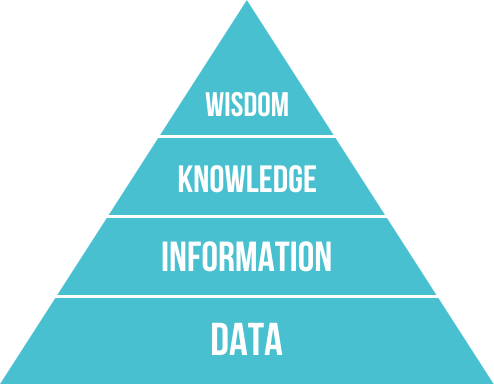
The data–information–knowledge–wisdom hierarchy. Image: Longlivetheux, Wikimedia Commons, CC BY-SA 4.0.
For this discussion the crucial step is the arrow from information to knowledge. It is the step where a person, not just a system, becomes necessary. Information can be stored, indexed, and retrieved; knowledge is enacted by a knower. This is precisely why knowledge management is not the same problem as information retrieval — and why a purely technical solution tends to stall at the boundary where interpretation begins. The classic formulation is attributable to Davenport and Prusak (1998), who describe knowledge as a fluid mix of framed experience, values, contextual information, and expert insight that provides a framework for evaluating and incorporating new experiences and information.1
What Makes Knowledge "Organizational"
Knowledge exists at more than one level. We usually separate it into three nested scopes:
- Individual knowledge — what a single person knows and can do, including personal experience and intuition.
- Group knowledge — what a team knows collectively, often distributed across members and coordinated through shared practice.
- Organizational knowledge — knowledge that has been institutionalized in routines, documents, norms, and shared structures, and that persists beyond any individual.
The jump from individual to organizational knowledge is not automatic. A great deal of organizational knowledge is distributed (no single person holds all of it), embedded (it lives in routines and tools, not just in heads), and path-dependent (it is shaped by the specific history of the organization). This is why knowledge is often described as "sticky": it is difficult to move from where it was created to where it is needed.2
A widely used distinction cuts across all three levels: the difference between explicit and tacit knowledge. Explicit knowledge can be expressed in formal, systematic language — words, numbers, formulas, diagrams — and shared as data. Tacit knowledge is personal, context-specific, and hard to formalize; it is rooted in action, experience, and involvement in a specific context.3 The two are not a binary in practice, but a spectrum of how readily something can be articulated.
Tacit Knowledge: The Part We Can't Fully Tell
The idea comes from Michael Polanyi, whose famous line — "we can know more than we can tell" — captures the whole problem. Think about recognizing a familiar face: you can do it reliably, but you cannot fully specify the rules you used. Polanyi argued that this tacit dimension is not a minor residue but a necessary part of all knowing: explicit knowledge always rests on tacit skills and judgements that we cannot completely make explicit.
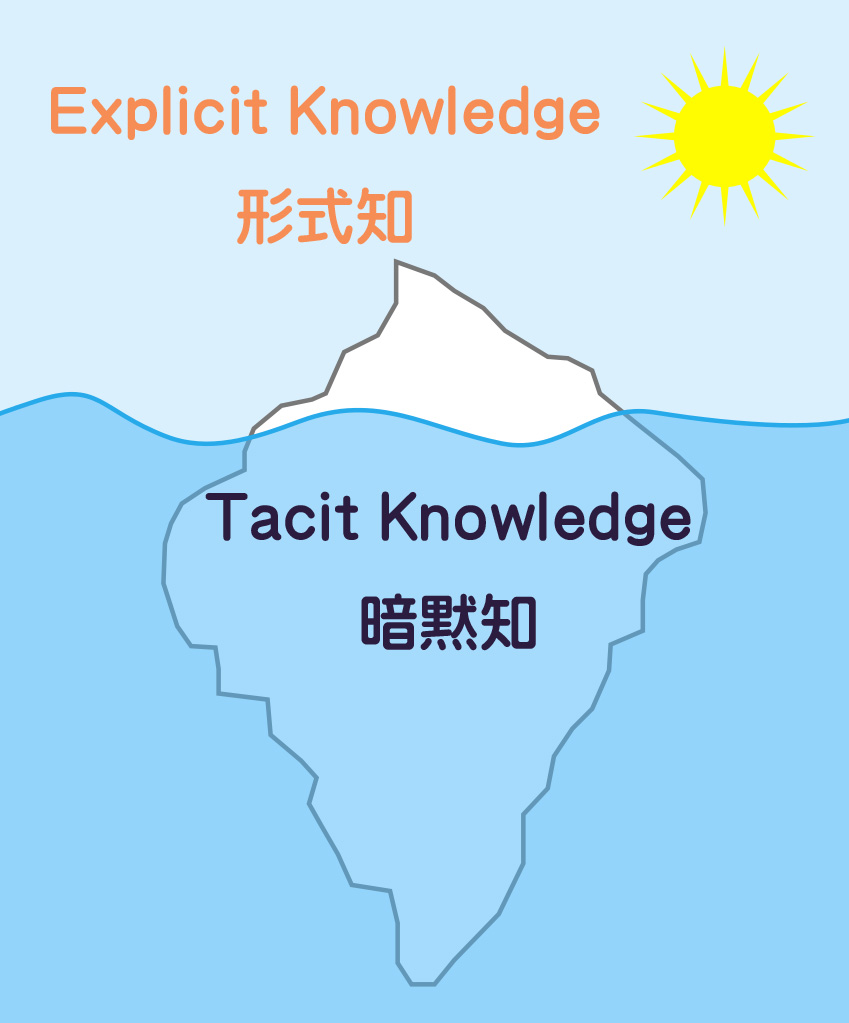
Explicit knowledge is the visible tip; tacit knowledge is the submerged mass that supports it. Image: ウィキ太郎 (Wiki Taro), Wikimedia Commons, public domain.
Two Dimensions: Technical and Cognitive
Nonaka's treatment is especially useful because it splits tacit knowledge into two dimensions that require very different handling.3
| Dimension | What it contains | Typical example | Ease of articulation |
|---|---|---|---|
| Technical | Procedural know-how, skills, craft | Riding a bike, tuning a model | Articulable in principle, often with practice or demonstration |
| Cognitive | Mental models, beliefs, values, assumptions, schemata | An expert's hunch that a result "looks wrong" | Very hard; often not consciously available |
The technical dimension is what we usually mean by "skills." It can often be transferred through apprenticeship, demonstration, and deliberate practice. The cognitive dimension is the harder one: it consists of internal models that quietly direct what a person notices, how they interpret a cue, and what they decide to do next. This is the layer that shapes intuition, and it is the layer that structured elicitation must target.
Taxonomies of Tacit Knowledge
Not all tacit knowledge is alike. Frank Blackler argues that knowledge is better described through the form it takes in an organization, distinguishing between knowledge that is embrained, embodied, encultured, embedded, and encoded.4 A different and influential cut comes from Harry Collins, who points out that some tacit knowledge is somatic (in the individual body, like a physical skill) while the most stubborn kind is collective — knowledge that only exists in a social group, cannot be reduced to individual rules, and is acquired only by belonging to that community for a period of time.5 Collective tacit knowledge is precisely the "implicit social, cultural, or belief" layer that builds day by day inside a lab and that individual interviews alone may not reach.
Organizational Knowledge Creation: The SECI Model
The SECI model — the best-known framework, from Ikujiro Nonaka and Hirotaka Takeuchi — describes how knowledge is created in an organization as a continuous interaction between tacit and explicit knowledge across four conversion modes: Socialization, Externalization, Combination, and Internalization.36
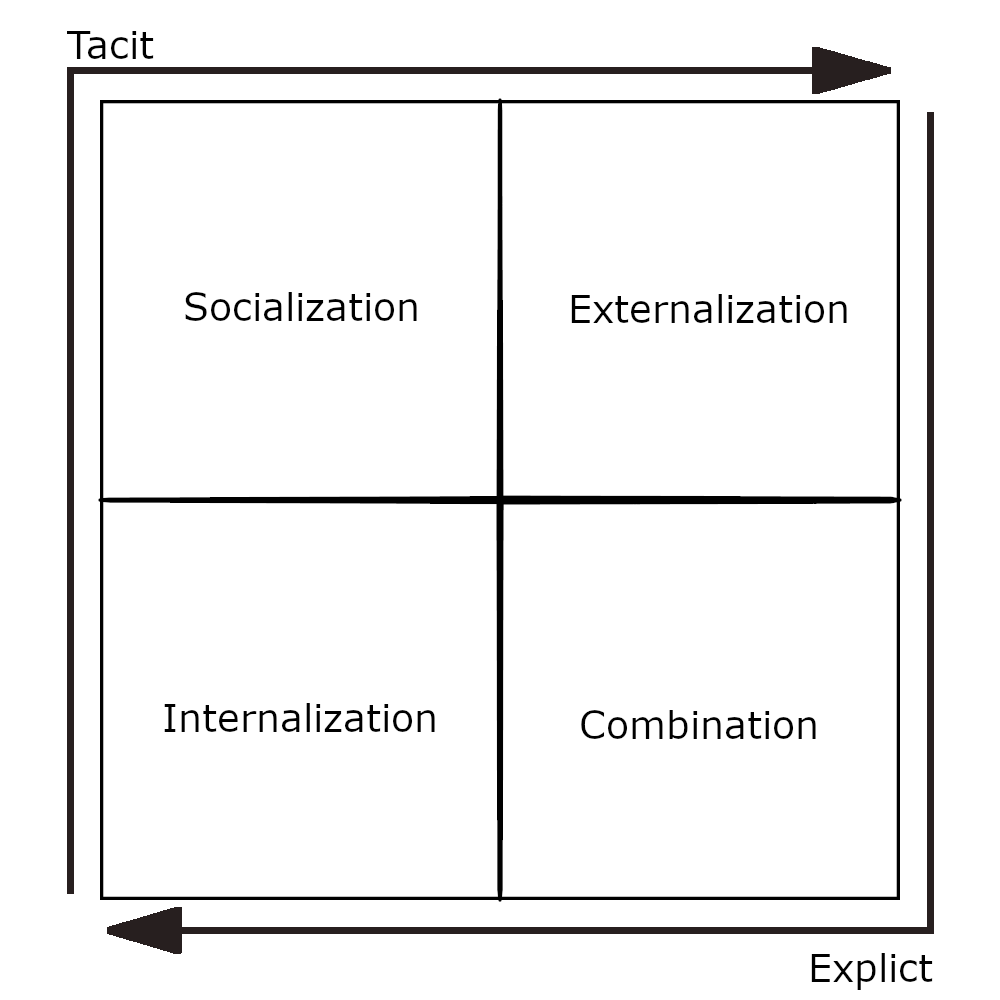
The SECI knowledge-conversion cycle. Image: タバコはマーダー, Wikimedia Commons, CC BY-SA 4.0.
The Four Conversion Modes
- Socialization (tacit → tacit). Knowledge is shared through direct experience: observation, imitation, apprenticeship, and informal conversation. No words are strictly required. A junior researcher learns how a senior frames a problem by working alongside them.
- Externalization (tacit → explicit). Tacit knowledge is articulated into explicit concepts — metaphors, analogies, narratives, models, diagrams. This is the conversion that produces shareable, reusable knowledge, and it is the hardest of the four.
- Combination (explicit → explicit). Explicit knowledge is reorganized, combined, and systematized: merging datasets, comparing reports, building a taxonomy or a knowledge graph.
- Internalization (explicit → tacit). Explicit knowledge is absorbed into practice through doing — "learning by doing" — and becomes part of an individual's tacit base.
The cycle is a spiral: knowledge moves between individuals, groups, and the organization, and each turn expands what the organization collectively knows. This study focuses almost entirely on Externalization, because it is the bottleneck. Socialization happens naturally in a lab; combination is increasingly automatable; internalization is personal. Externalization is the fragile step where otherwise-precious reasoning is lost.
Ba: The Shared Context
Conversion does not happen in a vacuum. Nonaka and Konno introduced the concept of ba — a shared context or "place" in which knowledge is created.7 Ba can be physical (a lab bench), virtual (a chat channel or shared document), mental (shared experience), or a combination. A meeting is a particularly rich ba: it is a bounded, shared space where participants compare observations, challenge interpretations, explain failures, and negotiate decisions in real time. Crucially, ba is also where the cognitive tacit knowledge of a group is visible — in the cues people react to and the assumptions they leave unstated.
Enabling Conditions
Nonaka, Toyama, and Konno later described the conditions that let this knowledge spiral turn:8 intention (a shared purpose), autonomy (freedom to act), fluctuation and creative chaos (productive disruption), redundancy (overlapping information), and requisite variety (internal diversity matching environmental complexity). A research lab satisfies most of these almost by design — which is exactly why it generates so much tacit knowledge and why that knowledge is so easy to lose.
Externalization: Why Writing It Down Is Not Enough
Externalization is more than documenting a conclusion. A conclusion is a point; externalization is the surrounding structure that makes the point understandable and reusable. In a lab meeting, that structure includes the observation that started the discussion, the critical cue that changed how people read the problem, the rationale for the chosen option, the experience someone contributed from earlier work, the condition under which the solution is expected to work, the exception where it does not, and the risk the team accepted. Lose those and you keep the "what" while losing the "why" and the "when."
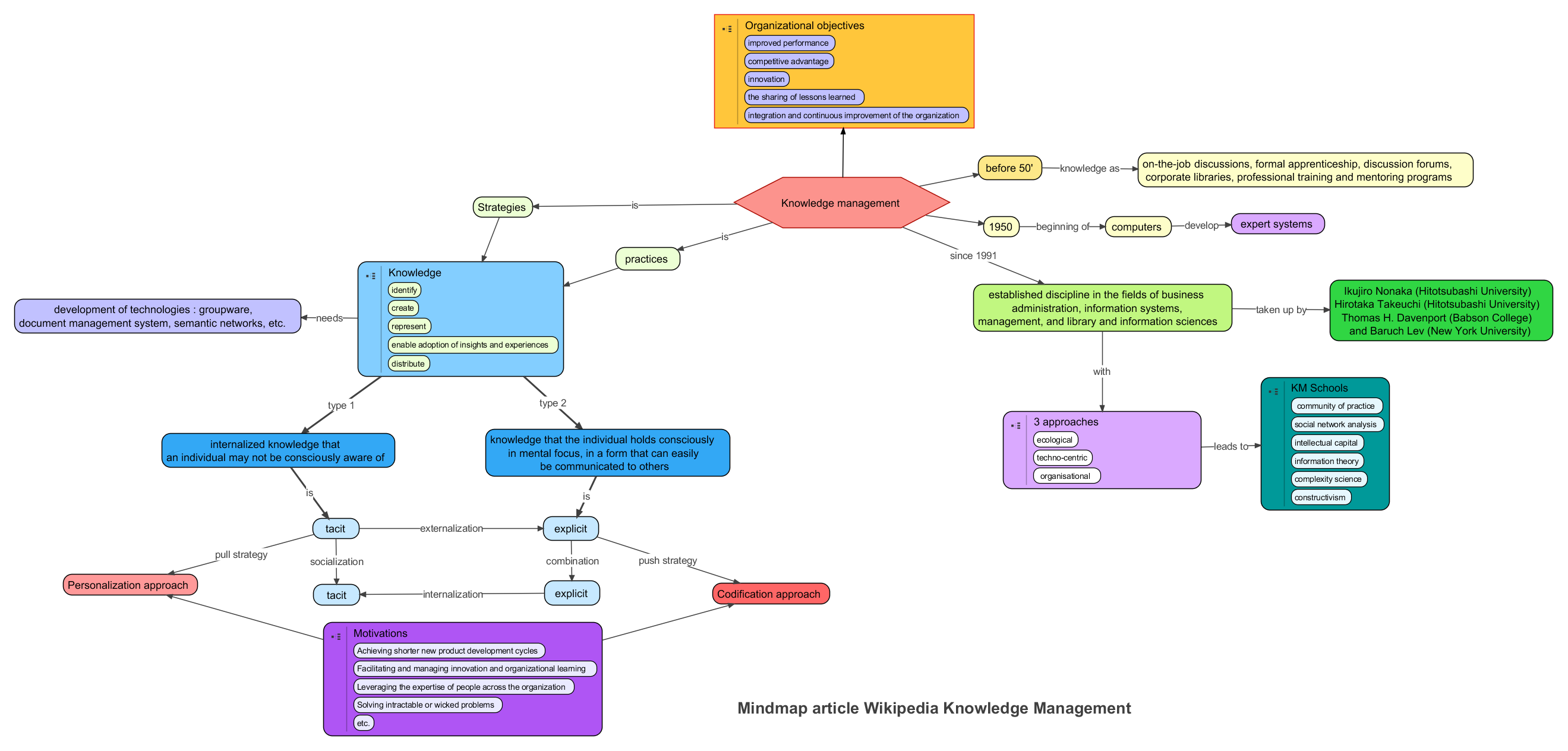
A knowledge-management cycle: creation, storage, transfer, and application feed one another. Image: Abottineau, Wikimedia Commons, CC BY-SA 3.0.
Context matters for externalization in a way that is easy to underestimate. The broader observation — argued in the lab's own elicitation notes, drawing on Hemmecke et al. — is that individual, social, cultural, and historical context must all be considered; what is tacit in one community may be obvious or even irrelevant in another. In a multilingual, multicultural lab, some "tacit" friction is really just an unshared frame of reference.
Externalization fails for several distinct reasons, and it helps to name them:
- Cognitive. The knower may not have conscious access to their own reasoning. Asking "why?" can produce a plausible reconstruction rather than the actual decision process.
- Linguistic. Some knowledge resists propositional form. Metaphor and narrative can carry it further than definitions.
- Social. Hierarchy, trust, and face-saving change what people are willing to say, and to whom.
- Motivational. Articulating knowledge is effortful and often unrewarded; the incentive to document is weaker than the incentive to move on.
A good externalization method has to acknowledge all four, which is why the practical answer is usually a structured interview rather than a form to fill in.
The Laboratory as a Ba
Why a research laboratory? Because it concentrates the problem. A lab continuously creates knowledge through experiments, technical discussion, collaborative debugging, and reflection on prior work. Some of it becomes explicit — papers, reports, code, logs, notebooks. But a large share stays tacit: personal experience, professional judgement, intuition, and a shared understanding of local context.
Meetings are the densest site of this process. They function as the lab's ba: a shared space where a decision is not just made but justified in conversation. At the same time, a meeting transcript is a poor externalization of itself. Speech is disfluent, interruptive, full of underspecified references to earlier turns, and distributed across speakers.9 A reasoning chain can be perfectly clear to everyone in the room and nearly impossible to reconstruct from the transcript a month later. Automatic transcription adds its own noise: names, acronyms, and model identifiers get mangled inconsistently, and a single lexical error can split one concept into two entities downstream.10
This is why transcription alone is not externalization. A transcript preserves the chronology of a conversation; it does not preserve the epistemic structure. The decision, its rationale, its conditions, and its risks all sit in the same stream of text, in no particular order, often several speakers apart.
Eliciting Tacit Knowledge
If tacit knowledge is hidden or unstated, we do not "capture" it so much as elicit it. The lab notes put it well: people do not usually state their beliefs and mental models, so we need methods that uncover non-obvious cognitive detail through structured interviews. There is no single method that does everything, but a small toolkit has proven durable.
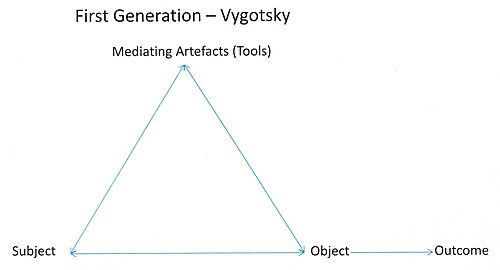
The basic mediated-action triangle that activity theory builds on. Image: Pronacampo9, Wikimedia Commons, CC BY-SA 4.0.
Activity Theory as the Frame
Before probing a task, it helps to map the activity around it. Activity theory (developed by Vygotsky, Leontiev, and Engeström) treats a unit of work as a system of elements: the actor or subject, the object of activity, the goal, the motive, the tools and artefacts that mediate the work, the rules and norms, the community, the division of labour, the conditions, and the outcome. Mapping these elements prevents the classic mistake of extracting a piece of knowledge while silently dropping the context that gave it meaning. In practice this becomes a short worksheet that the interviewer fills with the participant before any deep probing.
Critical Incident Technique
The critical incident technique, introduced by John Flanagan, is beautifully simple: instead of asking people to describe how they usually work, ask them to recall a specific incident that was unusual — a failure, a surprise, a disagreement, a decision point.11 Concrete incidents pull out real reasoning, because they have stakes, a trigger, a deviation from routine, and a moment where judgement mattered. Generic questions ("how do you normally do this?") tend to produce generic, socially smoothed answers; an incident forces specifics.
Applied Cognitive Task Analysis (ACTA)
ACTA, developed by Militello and Hutton, is the workhorse for decomposing an expert's cognitive demands.12 It has three stages:
- Task diagram. Break the activity into roughly three to six major steps and mark which are cognitively demanding — the steps where an experienced person mentally organizes the work rather than just clicking.
- Knowledge audit. Probe each critical step for critical cues ("what did you notice first?"), judgements ("what did you decide, and why did that option look preferable?"), strategies and rules of thumb, conditions, exceptions, trade-offs, uncertainty, and novice traps.
- Simulation interview. Present a scenario derived from the incident, then change one contextual variable at a time (less time, conflicting evidence, a different role involved, higher cost of failure) and ask how the reasoning and action would change.
The most useful probes are remarkably consistent: "How did you know?" and "What would a less-experienced person notice instead?" ACTA also asks about the social layer — whether lab norms, hierarchy, trust, or prior relationships changed what the person was willing to say, and what they expected others to infer without being told.
Repertory Grid Technique
Where ACTA goes deep on one incident, the Repertory Grid Technique (from George Kelly's personal construct theory) goes across several comparable cases.13 It works by triading: show the participant three similar cases, tools, or approaches, ask which two are alike and how the third differs, and record the construct (the tacit dimension along which they are being compared). Repeating this surfaces the personal constructs someone uses to make distinctions — dimensions they may never have articulated, but which drive their choices. RGT needs at least three sufficiently similar and familiar cases to work well, and the construct and its explanation matter far more than any numeric rating.
Co-construction and Consensus
Individual elicitation is not the end. What one person reports may be personal preference rather than a lab-wide practice, may be outdated, or may contradict a colleague. Co-construction returns the individual findings to the group, where members can consolidate shared practice, preserve legitimate context-dependent variation, record unresolved disagreement, and mark knowledge that should not be stored for sensitivity reasons. The safeguard is procedural: show anonymized findings, let each person explain their own reasoning before the group evaluates it, and never treat majority agreement as proof that a minority view is wrong.
Which Method, When?
The methods are complementary, not competing. The lab's recommendation is to start with critical-incident analysis plus ACTA as the primary procedure, and to add RGT only when the participant can compare at least three sufficiently similar, familiar cases.
| Method | Best for | Main limitation |
|---|---|---|
| Activity Theory map | Framing the context and boundary of the activity | Descriptive; does not probe reasoning |
| Critical Incident Technique | Concrete, grounded, decision-rich episodes | Depends on memory of a good incident |
| ACTA | Cues, judgements, strategies, novice traps | Interviewer-intensive; needs a critical step |
| Repertory Grid | Comparative dimensions across cases | Needs three homogeneous, familiar cases |
| Co-construction | Validating individual findings with the group | Risk of conformity if run before individual elicitation |
One design rule follows from all of this: conduct individual elicitation before co-construction. Group discussion first tends to smother the very cognitive detail that makes elicited knowledge valuable.
From Elicited Knowledge to a Representation
Elicitation produces rich but messy material. To be reusable, it needs to be represented. The most promising representation for decision-rich conversation is a knowledge graph, because it models knowledge as entities and explicitly typed relationships rather than as an undifferentiated passage of text.[^hogan][^ji]
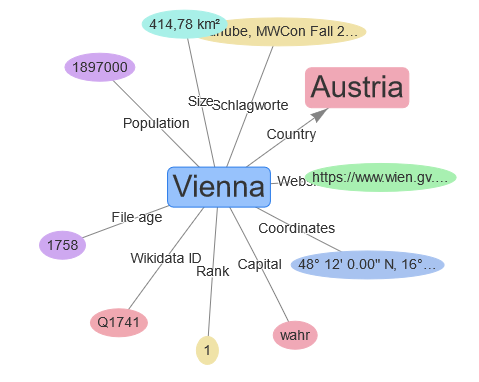
A visualized knowledge graph: nodes are entities, edges are typed relations. Image: Krabina, Wikimedia Commons, CC BY 4.0.
The epistemic graph in this line of work separates constructs into three roles, each answering a different question about a decision. This is the ontology that emerged from the lab's design.
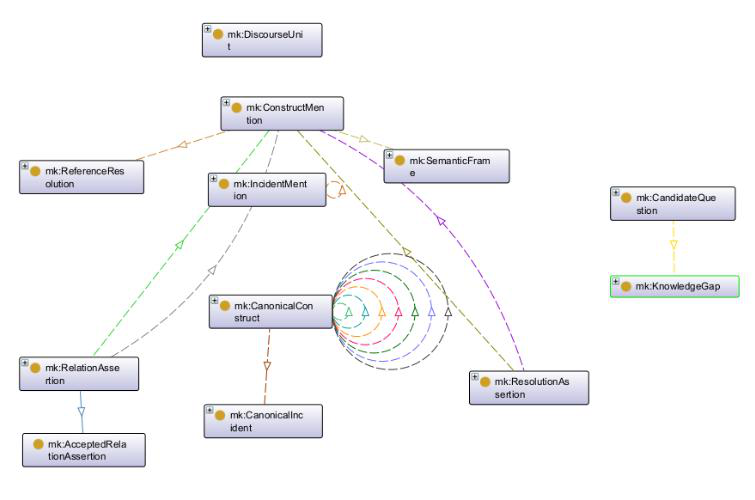
The epistemic ontology separating commitments, evidential basis, and applicability boundary. Figure from the author's TEEP@AsiaPlus final report (2026).
| Role | Constructs | The question it answers |
|---|---|---|
| Commitment | DECISION, ACTION | What did the group commit to, and what follows from it? |
| Evidential basis | OBSERVATION, CRITICAL_CUE, RATIONALE, EXPERIENCE, EXPERT_JUDGEMENT | Why was the commitment considered reasonable? |
| Applicability boundary | CONDITION, EXCEPTION, RISK | When does it apply, when does it not, and what threatens it? |
The point of the ontology is not taxonomy for its own sake. A rationale, a cue, a risk, and a condition are not interchangeable entities; each contributes differently to understanding a decision. The core relations express four complementary meanings: SUPPORTS (a rationale or experience justifies a decision), MOTIVATES (an observation or cue triggers one), GATES (a condition or exception bounds where it applies), and RESULTS_IN (a decision produces a follow-up action). The result is a graph whose edges carry the reasoning, not just the topic.
Formally, externalized knowledge can be treated as a graph where is the set of epistemic constructs and is the set of typed relations drawn from . A candidate gap for a decision is then the absence of an accepted evidential basis — no such that or . At the individual level, knowledge decomposes as , and it is only the part that a system can store directly; the rest has to be elicited and converted.
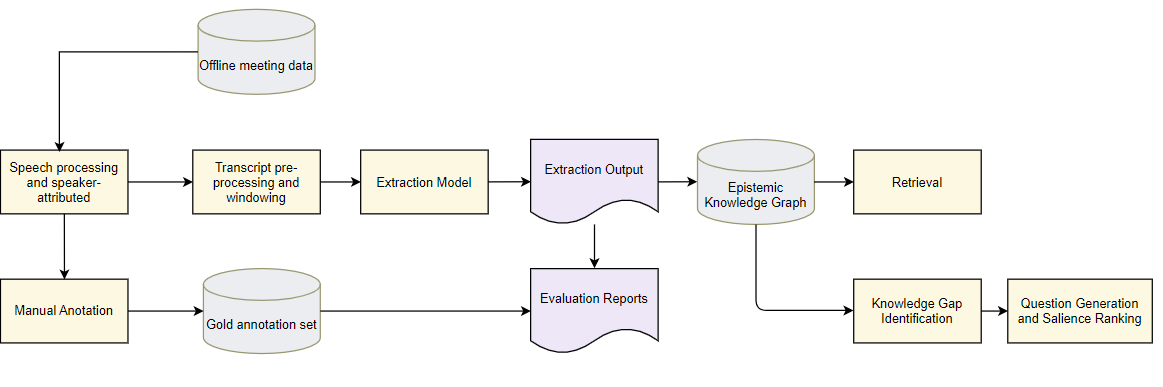
The externalization pipeline: transcription, epistemic extraction, conservative entity resolution, RDF projection, and validation. Figure from the author's TEEP@AsiaPlus final report (2026).
Two design commitments keep such a graph honest:
- Evidence-grounded provenance. Every construct stays linked to the meeting, speaker, timestamp, and verbatim transcript evidence it came from. A normalized or interpreted form is stored as a derived representation; the original segment remains the traceable source. Retrieved knowledge is therefore inspectable rather than authoritative by default.
- A lifecycle from candidate to validated. A statement produced automatically from a meeting is not immediately an organizational fact. It is an extracted candidate until it is reviewed. Keeping that status visible is what separates "the system found this" from "the organization accepts this."
This representation also makes absence useful. Under an open-world interpretation, a decision with no accepted supporting rationale, cue, or experience is not proof that the reasoning did not exist — it is a candidate knowledge gap. The caution is that a missing relation can come from three very different causes: the knowledge was never articulated, the transcript is incomplete, or the extraction failed to recognize a statement that is actually there. So gap identification has to be conservative, and it should check whether the missing link is a real gap or a processing error before asking a human about it.
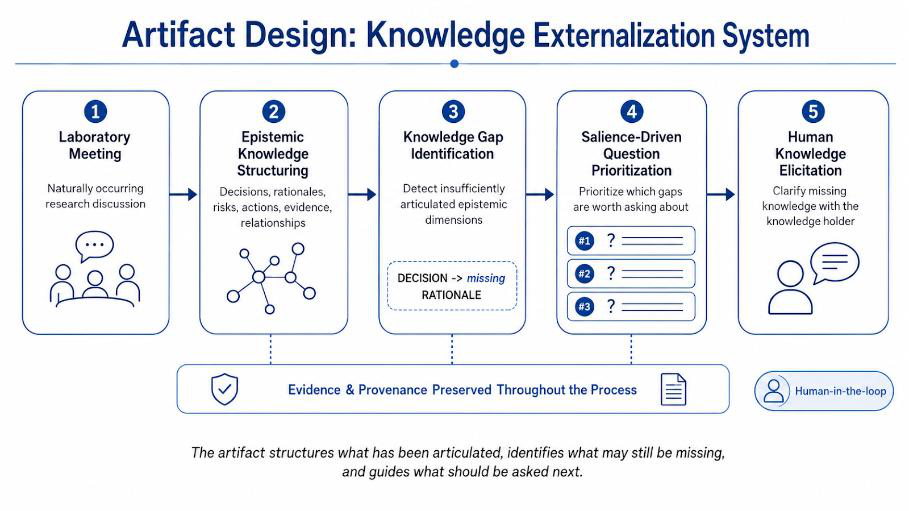
The conceptual artifact: meeting material becomes an epistemic graph, which can surface gaps and prioritize questions. Figure from the author's TEEP@AsiaPlus final report (2026).
Once gaps are identified, the natural next question is which gap to ask about first — since any meeting could generate dozens of possible questions. The notion of question salience ranks questions by their expected contribution to understanding, so limited expert time goes to the questions whose answers would add the most. This is the point where a representational system feeds back into human elicitation: gaps in the graph become targeted, prioritized interview questions, and the answers deepen the graph. It is a loop, not a pipeline.
Open Problems and Limitations
It would be dishonest to present this map as settled. Several questions are genuinely open:
- Is a detected gap meaningful? Open-world reasoning can flag absence, but only domain experts can say whether an absence is a real lack of knowledge, an artifact of the transcript, or simply something that was never worth stating.
- Does salience actually help? Ranking questions is a prioritization principle; whether the highest-salience questions produce the most valuable knowledge still needs human-centered evaluation.
- Do the methods do what they claim? ACTA and RGT are well-established, but their value in a specific multilingual, multicultural lab — and for cognitive tacit knowledge specifically — has to be tested, not assumed.
- Whose knowledge is being externalized? Externalization is not neutral. Senior voices dominate, hierarchy affects what is said, and a single "canonical" account can erase legitimate context-dependent differences. Co-construction is a mitigation, not a cure.
- Ethics and sensitivity. Recording and representing conversations raises real questions of consent, anonymization, retention, and whether a graph can reveal more than any participant intended. These have to be handled at the design stage, not retrofitted.
Takeaways
- Organizationally relevant knowledge is distributed, embedded, and path-dependent — which is why it is sticky and why individual memory is not a durable store.
- Tacit knowledge has a technical dimension (skills) and a cognitive dimension (mental models, beliefs, values). The cognitive dimension is the hard target and the one that most shapes decisions.
- The SECI model frames organizational knowledge creation as a spiral; externalization (tacit to explicit) is the fragile, high-value conversion.
- Writing down the conclusion is not externalization. The rationale, cue, condition, exception, and risk are the knowledge.
- Tacit knowledge is elicited, not captured. Activity theory frames it, critical-incident analysis grounds it, ACTA decomposes it, RGT compares across cases, and co-construction validates it — individually first, then together.
- A knowledge graph can hold the reasoning explicitly, with provenance and a candidate-to-validated lifecycle, and it turns absence into checkable questions rather than silent gaps.
The through-line is that externalizing tacit knowledge is fundamentally a human process that representation can support but not replace. The graph does not create the knowledge; it gives the results of honest conversation a place to live, and it tells us where the conversation should go next.
References
- M. Polanyi, The Tacit Dimension. University of Chicago Press, 1966.
- I. Nonaka, "A dynamic theory of organizational knowledge creation," Organization Science, vol. 5, no. 1, pp. 14–37, 1994. DOI
- I. Nonaka and H. Takeuchi, The Knowledge-Creating Company. Oxford University Press, 1995.
- I. Nonaka and N. Konno, "The concept of 'Ba': Building a foundation for knowledge creation," California Management Review, vol. 40, no. 3, pp. 40–54, 1998. DOI
- I. Nonaka, R. Toyama, and N. Konno, "SECI, Ba and leadership: A unified model of dynamic knowledge creation," Long Range Planning, vol. 33, no. 1, pp. 5–34, 2000.
- F. Blackler, "Knowledge, knowledge work and organizations: An overview and interpretation," Organization Studies, vol. 16, no. 6, pp. 1021–1046, 1995. DOI
- H. Collins, Tacit and Explicit Knowledge. University of Chicago Press, 2010.
- S. D. N. Cook and J. S. Brown, "Bridging epistemologies: The generative dance between organizational knowledge and organizational knowing," Organization Science, vol. 10, no. 4, pp. 381–400, 1999.
- M. Alavi and D. E. Leidner, "Review: Knowledge management and knowledge management systems," MIS Quarterly, vol. 25, no. 1, pp. 107–136, 2001. DOI
- T. H. Davenport and L. Prusak, Working Knowledge: How Organizations Manage What They Know. Harvard Business School Press, 1998.
- G. Szulanski, "Exploring internal stickiness: Impediments to the transfer of best practice within the firm," Strategic Management Journal, vol. 17, pp. 27–43, 1996.
- V. Ambrosini and C. Bowman, "Tacit knowledge: Some suggestions for operationalization," Journal of Management Studies, vol. 38, no. 6, pp. 811–829, 2001.
- R. L. Ackoff, "From data to wisdom," Journal of Applied Systems Analysis, vol. 16, pp. 3–9, 1989.
- J. C. Flanagan, "The critical incident technique," Psychological Bulletin, vol. 51, no. 4, pp. 327–358, 1954. DOI
- L. G. Militello and R. J. B. Hutton, "Applied cognitive task analysis (ACTA): A practitioner's toolkit for understanding cognitive task demands," Ergonomics, vol. 41, no. 11, pp. 1618–1641, 1998. DOI
- G. A. Kelly, The Psychology of Personal Constructs. W. W. Norton, 1955.
- G. Klein, L. Calderwood, and D. MacGregor, "Critical decision method for eliciting knowledge," IEEE Transactions on Systems, Man, and Cybernetics, vol. 19, no. 3, pp. 462–472, 1989.
- Y. Engeström, Learning by Expanding: An Activity-Theoretical Approach to Developmental Research. Orienta-Konsultit, 1987.
- J. Carletta et al., "The AMI meeting corpus: A pre-announcement," in Machine Learning for Multimodal Interaction, pp. 28–39, 2005.
- A. Radford et al., "Robust speech recognition via large-scale weak supervision," arXiv:2212.04356, 2022. arXiv
- A. Hogan et al., "Knowledge graphs," ACM Computing Surveys, vol. 54, no. 4, 2021. arXiv
- S. Ji, S. Pan, E. Cambria, P. Marttinen, and P. S. Yu, "A survey on knowledge graphs: Representation, acquisition, and applications," IEEE TNNLS, vol. 33, no. 2, pp. 494–514, 2022. arXiv
- D. Yu, K. Sun, C. Cardie, and D. Yu, "Dialogue-based relation extraction," in Proceedings of ACL, pp. 4927–4940, 2020.
- H. Knublauch and D. Kontokostas, eds., "Shapes Constraint Language (SHACL)," W3C Recommendation, 2017. W3C
- K. Peffers, T. Tuunanen, M. A. Rothenberger, and S. Chatterjee, "A design science research methodology for information systems research," JMIS, vol. 24, no. 3, pp. 45–77, 2007.
- M. R. Maruf, "Design of an organizational knowledge externalization system through epistemic meeting knowledge graph extraction and saliency-driven tacit knowledge elicitation," TEEP@AsiaPlus Final Report, NTUST, 2026.
Citation
If you want to reference this note:
Ma'ruf, Muhammad Rifqi. "Tacit Knowledge inside Organizational Knowledge." rifqimaruf.dev (2026). https://rifqimaruf.dev/writing/tacit-knowledge-inside-organizational-knowledge/
Footnotes
-
T. H. Davenport and L. Prusak, Working Knowledge: How Organizations Manage What They Know. Harvard Business School Press, 1998. ↩
-
G. Szulanski, "Exploring internal stickiness: Impediments to the transfer of best practice within the firm," Strategic Management Journal, vol. 17, pp. 27–43, 1996. ↩
-
I. Nonaka, "A dynamic theory of organizational knowledge creation," Organization Science, vol. 5, no. 1, pp. 14–37, 1994. ↩ ↩2 ↩3
-
F. Blackler, "Knowledge, knowledge work and organizations: An overview and interpretation," Organization Studies, vol. 16, no. 6, pp. 1021–1046, 1995. ↩
-
H. Collins, Tacit and Explicit Knowledge. University of Chicago Press, 2010. ↩
-
I. Nonaka and H. Takeuchi, The Knowledge-Creating Company: How Japanese Companies Create the Dynamics of Innovation. Oxford University Press, 1995. ↩
-
I. Nonaka and N. Konno, "The concept of 'Ba': Building a foundation for knowledge creation," California Management Review, vol. 40, no. 3, pp. 40–54, 1998. ↩
-
I. Nonaka, R. Toyama, and N. Konno, "SECI, Ba and leadership: A unified model of dynamic knowledge creation," Long Range Planning, vol. 33, no. 1, pp. 5–34, 2000. ↩
-
J. Carletta et al., "The AMA meeting corpus: A pre-announcement," in Machine Learning for Multimodal Interaction, pp. 28–39, 2005. ↩
-
A. Radford et al., "Robust speech recognition via large-scale weak supervision," arXiv:2212.04356, 2022. ↩
-
J. C. Flanagan, "The critical incident technique," Psychological Bulletin, vol. 51, no. 4, pp. 327–358, 1954. ↩
-
L. G. Militello and R. J. B. Hutton, "Applied cognitive task analysis (ACTA): A practitioner's toolkit for understanding cognitive task demands," Ergonomics, vol. 41, no. 11, pp. 1618–1641, 1998. ↩
-
G. A. Kelly, The Psychology of Personal Constructs. W. W. Norton, 1955. ↩